
Bat Mitzvahs and Bar Mitzvahs are milestones in any Jewish person’s life. On the day of their Bar or Bat Mitzvah, a child becomes an adult and takes on new, meaningful responsibilities. But what’s the difference between the two? Read on to find out.
What Does “Bar Mitzvah” Mean?
“Bar Mitzvah” means “Son of the Commandment.” It’s a coming of age ceremony that happens when a boy is typically 13 years old. It signifies a boy’s transition into a man and the new expectations that come along with it. When a boy becomes a Bar Mitzvah, he becomes responsible for upholding the 613 mitzvot, or commandments, in the Torah. These dictate everything from Jewish ritual practices to his responsibilities to his family, community, and more.
Origins of Bar Mitzvahs
The history of Bar Mitzvahs stretches all the way back to biblical times. The Torah tells the story of Abraham and his son Isaac. It states that when Isaac was “weaned,” Abraham had a great feast to celebrate. The rabbis interpreted this to mean that, on the day Isaac turned 13, he was “weaned” from childhood and became an adult.
The term “Bar Mitzvah” was first used by Mordecai ben Hillel in the 14th century. In the centuries to follow, Bar Mitzvah ceremonies and parties became a standard part of life for Jewish boys.
How Bar Mitzvahs Work
In today’s world, many think of Bar Mitzvahs as blow-out parties that Jewish teens have, but the true Bar Mitzvah is the religious ceremony that precedes the celebration. Here’s what to expect:
-
Aliyah: During a boy’s Bar Mitzvah, he is called upon during Saturday morning Shabbat services to read the week’s Torah portion and lead the congregation in various prayers. This is known as an aliyah.
-
D’var Torah: After the aliyah, a boy will give a speech about the Torah portion he was called to read and what it means to him. This speech is known as a d’var Torah.
-
Tefillin: A boy will also wrap tefillin at his Bar Mitzvah. These are two boxes that contain Torah portions, which are connected to the arm and head with leather straps. Wrapping tefillin is one of the 613 mitzvot.
-
Parental Blessings: Lastly, the parents of the Bar Mitzvah will come forward and say blessings over their child.
After the ceremony, friends and family celebrate with food, dancing, speeches, and gifts.
What Does “Bat Mitzvah” Mean?
“Bat Mitzvah” means “Daughter of the Commandment.” Like Bar Mitzvahs, Bat Mitzvahs are also coming of age ceremonies, but for girls rather than boys. Bat Mitzvahs can happen slightly earlier than Bar Mitzvahs, beginning at age 12 rather than 13. Bat Mitzvahs also mark the point at which girls become women and take on the responsibility of upholding all 613 mitzvot.
Origins of Bat Mitzvahs
Bat Mitzvahs are a relatively recent development in Jewish life. Coming of age ceremonies for girls began to appear in the late 19th century across Baghdad, France, and Italy. In America in 1922, a rabbi held a ceremony for his daughter at his synagogue that featured some characteristics of a Bar Mitzvah. This event is credited as being the first American Bat Mitzvah. By the end of the 20th century, the Bat Mitzvah became as popular as the Bar Mitzvah.
How Bat Mitzvahs Work
Bat Mitzvahs can vary greatly depending on the denomination of Judaism. In reform, reconstructionist, and conservative Judaism, Bat Mitzvah ceremonies follow the same pattern as Bar Mitzvahs, without the wrapping of the Tefillin. In Orthodox Judaism, girls typically do not read from the Torah, or do so only in front of other women, rather than in front of the whole congregation.
Bat Mitzvah vs. Bar Mitzvah: Key Differences
While Bar and Bat Mitzvahs share a number of similarities, the two ceremonies aren’t exactly the same. Let’s review the key differences in Bat vs Bar Mitzvahs
|
Bar Mitzvah |
Bat Mitzvah |
|
|
Age |
13 |
12 or 13 |
|
Meaning |
Means “Son of the Commandment” |
Means “Daughter of the Commandment” |
|
Ceremony |
Includes a Torah reading, speech, tefillin, and parental blessings. |
Reconstructionist, Reform, and Conservative ceremonies include a Torah reading, speech, and parental blessings. Orthodox ceremonies only include a speech and parental blessing. |
|
History |
Earliest mention is in the 14th century. |
Earliest mention is in the 20th century. |
Judaica for Bar and Bat Mitzvahs
In addition to the prayers, Torah readings, and speeches, Bat and Bar Mitzvahs involve a number of Jewish ritual objects, known as Judaica. Many of these objects are used to fulfill the 613 mitzvot, like tefillin, whereas other objects are used in the celebration of holidays like Hanukkah, Passover, and Rosh Hashanah.
Bat and Bar Mitzvahs involve the following ritual objects:
-
Kiddush cups: Kiddush cups are used when saying the Kiddush, which sanctifies holy days like Shabbat. At a child’s Bat or Bar Mitzvah, they’ll often lead the congregation in saying the Kiddush.
-
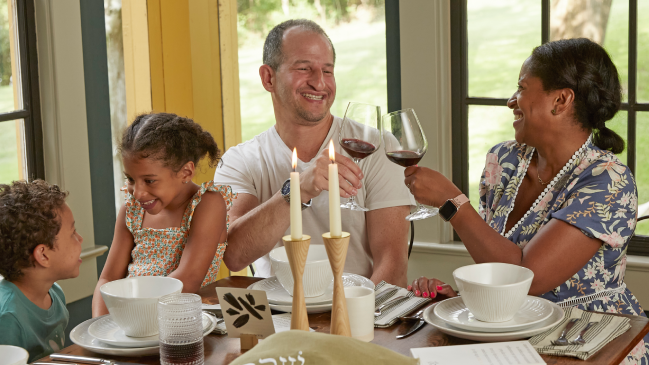
Candle sticks: Candle sticks are also involved in Shabbat celebrations. A Bat Mitzvah has the honor of lighting the candle sticks at her ceremony.
-
Talit: A talit is a prayer shawl that boys begin wearing on their Bar Mitzvah and at every prayer service that follows. Depending on the denomination, many girls are gifted talits at their Bat Mitzvah, too.
Choosing Meaningful Bat and Bar Mitzvah Gifts
It’s customary to bring a gift to a Bat or Bar Mitzvah to help in the celebration. If you have one upcoming, consider one of these meaningful gifts:
-
Kiddush cup: Kiddush cups are central to all Jewish holidays. Consider a Kiddush cup with a modern design to blend in with their home decor.
-
Candle holders: Another key gift for all holidays, candle holders are particularly common for Bat Mitzvahs.
-
Jewish jewelry: Gift a necklace with a Jewish religious symbol on it, like the Star of David.
-
Money in multiples of $18: In Judaism, the number 18 represents life. When giving money, it’s customary to give it in denominations of $18 as a toast to their life to come.
Shop Contemporary Judaica from Oneg Home
For contemporary, thoughtful Judaica that they’ll be able to cherish for years to come, shop Oneg Home. We carry a selection of Jewish ritual objects, guidebooks, conversation starters and more that make celebrating Jewish holidays accessible and meaningful. Find your next Bar or Bat Mitzvah gift in our selection.